
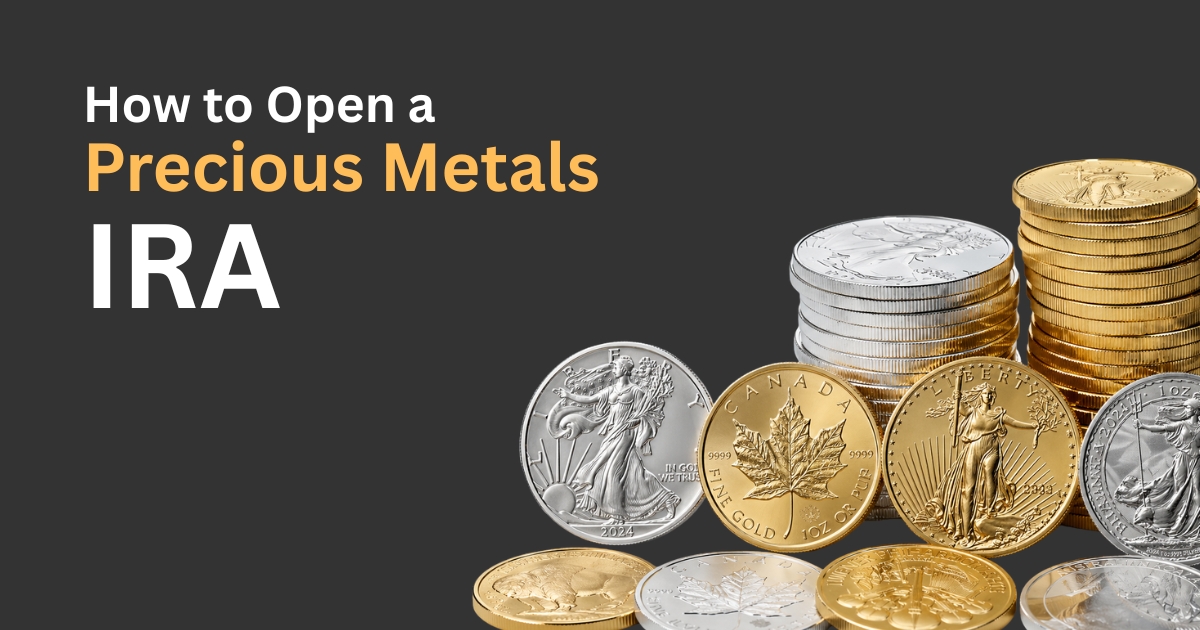
How to Open a Precious Metals IRA
If you’re exploring retirement strategies beyond stocks and bonds, a self-directed precious metals IRA could be worth understanding. Physical gold, silver, platinum, and palladium have played a role in wealth preservation for centuries — and today’s IRS-approved IRA structure allows qualified retirement savers to include these assets within a tax-advantaged account.
This guide walks you through everything you need to know: what a precious metals IRA is, the advantages it may offer, the most common funding sources, and one critically important concept every investor should understand before purchasing — the difference between the bid-ask spread and your actual break-even point.
What Is a Self-Directed Precious Metals IRA?
A self-directed precious metals IRA is an Individual Retirement Account that holds physical precious metals rather than — or in addition to — traditional paper-based assets like stocks, mutual funds, or ETFs. It operates under the same IRS framework as a conventional IRA, but requires a specialized IRS-approved custodian and an approved depository for secure metal storage.
Eligible metals that may be held inside a precious metals IRA include:
- Gold bullion coins and gold bars meeting IRS fineness standards (.9950 pure or higher)
- Silver bullion coins and silver bars (.9990 pure or higher)
- Platinum bullion and platinum coins (.9995 pure or higher)
- Palladium bullion and palladium coins (.9995 pure or higher)
Common IRA-approved products include American Gold Eagles, American Silver Eagles, Canadian Gold Maple Leafs, Canadian Silver Maple Leafs, Austrian Philharmonic coins, and bars from accredited refiners such as PAMP Suisse, Credit Suisse, and Johnson Matthey.
There are two primary structures:
Traditional Precious Metals IRA: Pre-tax contributions; taxes deferred until withdrawal.
Roth Precious Metals IRA: After-tax contributions; qualified withdrawals may be tax-free.
Advantages of a Precious Metals IRA
While no investment is without risk, precious metals IRAs offer several potential benefits that attract retirement-focused investors:
1. Portfolio Diversification
A precious metals IRA provides exposure to an asset class with a historically low correlation to equities and bonds. When traditional markets experience volatility, gold and silver have at times moved independently — offering a potential buffer within a diversified retirement portfolio.
2. Inflation Awareness
Gold and silver are tangible commodities with intrinsic value, and have long been associated with purchasing-power preservation. Retirement savers who are concerned about the long-term effects of inflation sometimes look to physical precious metals as one component of a broader strategy.
3. Tangible Asset Ownership
Unlike stocks or bond instruments, physical metals are real, finite commodities. Investors who prefer to hold assets they can verify by weight and purity often find comfort in the concrete nature of gold and silver held in a regulated depository on their behalf.
4. Tax-Advantaged Growth
A precious metals IRA follows the same IRS tax treatment as any other IRA. Depending on the account structure (Traditional or Roth), investors may benefit from tax-deferred growth or tax-free qualified withdrawals — the same advantages offered by conventional retirement accounts.
5. Geopolitical and Systemic Hedge
Gold in particular has historically maintained demand during periods of geopolitical uncertainty and financial system stress. For investors seeking a potential hedge against systemic risk, a physical gold IRA position may serve that purpose within a broadly diversified retirement strategy.
| Comparison: Precious Metals IRA vs. Traditional & Roth IRAsSee the table below for a side-by-side overview of key structural differences. |
| Feature | Precious Metals IRA | Traditional IRA | Roth IRA |
| Asset Type | Physical gold, silver, platinum, palladium | Stocks, bonds, mutual funds, ETFs | Stocks, bonds, mutual funds, ETFs |
| Tax on Contributions | Pre-tax (Traditional) or after-tax (Roth) | Pre-tax contributions | After-tax contributions |
| Tax on Withdrawals | Taxed as ordinary income (Traditional) | Taxed as ordinary income | Tax-free (qualified) |
| Custodian Required | IRS-approved self-directed custodian | Standard brokerage/bank custodian | Standard brokerage/bank custodian |
| Storage | IRS-approved depository required | Held in brokerage account | Held in brokerage account |
| Contribution Limit (2025) | $7,000 / $8,000 if 50+ | $7,000 / $8,000 if 50+ | $7,000 / $8,000 if 50+ |
Common Sources of Funds Used to Open a Precious Metals IRA
One of the most practical aspects of a precious metals IRA is the flexibility in how the account can be funded. Here are the most common methods:
Direct Contribution
Like any IRA, you can fund a precious metals IRA with annual contributions up to the IRS limit — $7,000 per year in 2025, or $8,000 if you are age 50 or older. These are cash contributions that the custodian then uses to purchase IRS-eligible metals on your behalf.
IRA Transfer
If you already hold a Traditional IRA or Roth IRA with another institution, you can transfer some or all of those assets directly to a self-directed precious metals IRA custodian. A direct trustee-to-trustee transfer is generally not a taxable event and does not count against your annual contribution limit.
401(k) or Qualified Plan Rollover
This is one of the most popular funding methods. If you have a 401(k), 403(b), 457(b), TSP, or other qualified employer plan — particularly from a previous employer — you may be eligible to roll those funds into a precious metals IRA. A direct rollover (where funds are transferred institution-to-institution) is typically not a taxable event.
Important: If you elect an indirect rollover — where funds are distributed to you first — you have 60 days to re-deposit the funds into a qualifying IRA. The distributing plan will withhold 20% for taxes, which you must cover out-of-pocket and reclaim at tax time. Direct rollovers avoid this complication entirely.
Rollover from an Existing Gold or Precious Metals IRA
If you already hold a precious metals IRA with another custodian, you can transfer or roll those assets to a new custodian without triggering a taxable event, subject to standard IRS rollover rules.
| Work With a Knowledgeable Dealer Before You FundThe source of funds you choose can have significant tax implications. A First Gold Group representative can walk you through the rollover or transfer process and coordinate directlywith your custodian — helping ensure a compliant, penalty-free transaction. |
Spread vs. Break-Even: The Most Important Pricing Concepts Before You Buy
Before purchasing precious metals for your IRA — or for any purpose — there are two related pricing concepts that every investor needs to understand. Most dealers talk about the spread. But as an investor, the number you should care about most is the break-even point. These are not the same thing, and the difference matters more than most people realize.
This distinction is especially critical for retirement-designated funds, where you are not speculating — you are preserving and growing wealth over time.
The Three Core Terms
Ask Price (Retail / Purchase Price): The price you pay when buying precious metals from a dealer. It is always higher than the spot price and reflects the product premium, dealer operating costs, and margin.
Bid Price (Immediate Buyback Price): The price a dealer will pay you if you want to sell your metals right now. This is typically below the current spot price.
Dollar Difference: The gap between the ask and the bid — the same $200 in both calculations below. But the two percentages it produces tell very different stories.
Two Formulas. Two Perspectives. One Number That Matters More.
Using a coin purchased at $3,400 retail with an immediate buyback price of $3,200:
Spread (Dealer Perspective): (Ask – Bid) / Ask = $200 / $3,400 = 5.88%
This tells you what portion of the purchase price is the dealer’s margin. It is a valid and real number — but it is calculated against the higher number: what you paid. This is the figure dealers typically lead with.
Break-Even (Investor Perspective): (Ask – Bid) / Bid = $200 / $3,200 = 6.25%
This tells you how much the market price must rise before you recover your purchase cost. It is calculated against the lower number: the current value of what you hold. This is the figure that determines when you stop being in the red.
Same $200 difference. Different denominator. Different percentage — and a different story about where you actually stand.
| The Key Insight: Dealers Focus on the Spread. Investors Should Focus on Break-Even. Spread = 5.88% (measured against the purchase price — reflects the dealer’s margin)Break-Even = 6.25% (measured against current value — the investor’s actual hurdle) The spread tells you what the dealer earns. The break-even tells you what the market must do for you to recover your money. For retirement investors, that second number isthe one that counts. |
Side-by-Side Example
The following figures are hypothetical and for illustration purposes only. Actual prices and spreads vary by product, market conditions, and dealer.
| Calculation | What It Means | |
| Ask Price (Retail / Purchase Price) | $3,400 / oz | What you pay the dealer |
| Bid Price (Immediate Buyback Price) | $3,200 / oz | What the dealer pays you right now |
| Dollar Difference | $200 / oz | The gap between purchase and immediate resale |
| Spread (Dealer Perspective) (Ask – Bid) / Ask | $200 / $3,400 = 5.88% | What portion of the purchase price is the dealer’s margin |
| Break-Even (Investor Perspective) (Ask – Bid) / Bid | $200 / $3,200 = 6.25% | How much the market must RISE for the investor to recover their cost — the number that matters for your retirement account |
A Plain-English Way to Think About It
“You purchase a coin for $3,400. If you needed to sell it today, you would receive $3,200 — a $200 difference. That $200 represents about 5.9% of what you paid. But you are not holding $3,400 right now — you are holding something currently worth $3,200. For that $3,200 to grow back to your purchase price of $3,400, it needs to increase by $200 on a $3,200 base. That is 6.25%. That is your break-even.”
The short version: the gap is roughly 6%, which means the market needs to move about 6% in your favor before you recover your purchase cost and begin building a real return.
Why This Matters More for Retirement Accounts
For funds designated for retirement, the break-even point carries particular weight because:
- Retirement accounts are long-term vehicles. The break-even point is the starting line — not the finish line — and understanding it helps set realistic expectations for your investment horizon.
- Early withdrawals from a Traditional Precious Metals IRA before age 59½ are subject to income taxes plus a 10% penalty. A forced sale before break-even is reached is doubly costly.
- Break-even varies significantly by product. Numismatic coins, collectibles, and certain proof coins carry much higher premiums — and therefore higher break-even thresholds — than IRS-approved standard bullion. For retirement accounts, lower break-even products are almost always preferable.
- Transparency on both numbers is a mark of a reputable dealer. Any dealer who can quote the spread but cannot explain the break-even in plain terms is leaving out the number that matters most to the investor.
At First Gold Group, our commitment is to transparent pricing — which means explaining both the spread and the break-even point clearly before you make any purchase decision.
| First Gold Group’s Approach: Lower Break-Even = Better Value for Retirement Investors For IRA accounts, we prioritize IRS-approved bullion products from sovereign mints andaccredited refiners — products that carry the lowest premiums and the most competitivebreak-even points in the secondary market. We discourage high-premium numismatic or collectible coins for retirement funding unlessthe client fully understands and accepts the wider break-even threshold. |
Step-by-Step: How to Open a Precious Metals IRA
Opening a self-directed precious metals IRA involves several coordinated steps. Here is a clear walkthrough of the typical process:
Step 1: Choose a Reputable Precious Metals Dealer
Your relationship with a knowledgeable, transparent precious metals dealer is the foundation of a successful precious metals IRA. A dealer like First Gold Group will guide you through product selection, help coordinate the custodian relationship, explain all pricing including the spread, and ensure the metals you purchase meet IRS eligibility requirements.
What to look for in a precious metals dealer:
- Transparent, upfront pricing with clear bid-ask spread and break-even disclosure
- Deep knowledge of IRS-eligible metals and fineness requirements
- Established relationships with reputable custodians and depositories
- No high-pressure sales tactics
- Verifiable business history and customer reviews
Step 2: Select an IRS-Approved Custodian
The IRS requires that all precious metals IRA assets be held by an approved, specialized custodian — not a standard brokerage. The custodian administers the account, coordinates metal purchases and storage, handles required reporting, and ensures IRS compliance.
First Gold Group clients frequently work with GoldStar Trust Company and Equity Trust Company, both well-established custodians in the self-directed IRA space. Your First Gold Group representative can assist with the custodian setup process.
Step 3: Open and Fund the Account
Once your custodian is selected, you will complete account opening paperwork for your self-directed precious metals IRA. You will then fund the account using one of the methods described earlier in this guide:
- Direct annual contribution (up to IRS limits)
- Direct transfer from an existing IRA
- Direct rollover from a 401(k), 403(b), 457(b), TSP, or other qualified plan
For rollovers and transfers, First Gold Group can coordinate directly with your current plan administrator and new custodian to facilitate a seamless, compliant transfer.
Step 4: Select IRS-Eligible Precious Metals
With your account funded, you will work with your First Gold Group representative to select the specific IRS-approved metals you wish to purchase. IRS requirements include minimum fineness standards, approved sources (national government mints, LBMA-approved refiners, ISO 9000-certified facilities), and specific condition requirements for proof coins.
Popular IRA-approved product categories include:
- American Gold Eagle and American Silver Eagle coins
- Canadian Gold Maple Leaf and Silver Maple Leaf coins
- Austrian Philharmonic gold and silver coins
- Gold, silver, platinum, and palladium bars from PAMP Suisse, Credit Suisse, Johnson Matthey, and other accredited refiners
This is the stage where the spread and break-even discussion is most important. Your First Gold Group representative will explain the ask price, bid price, spread, and break-even point for each product you are considering — so you know exactly how much the market needs to move before you are in a profitable position.
Step 5: Arrange IRS-Approved Secure Storage
IRS rules prohibit you from taking physical possession of precious metals held in your IRA. The metals must be stored in an IRS-approved depository — a specialized, insured, independently audited facility. Your custodian will coordinate storage arrangements with an approved facility.
Typically, storage options include:
- Segregated storage: Your metals are stored separately and identified as exclusively yours.
- Non-segregated (commingled) storage: Your metals are stored with other investors’ metals of the same type and purity, with your ownership tracked by account.
Storage fees vary by custodian and depository and should be clearly disclosed before you open an account.
Step 6: Monitor and Manage Your Account
A precious metals IRA is a long-term retirement vehicle. Once established, ongoing responsibilities include:
- Reviewing your allocation periodically relative to your overall retirement portfolio
- Staying informed about IRS rules for contributions, rollovers, and Required Minimum Distributions (RMDs)
- Working with your custodian on any transactions, account maintenance, or reporting requirements
- Staying current on precious metals market conditions and how they relate to your retirement timeline
Your First Gold Group representative remains available as a resource throughout the life of your account.
Key Takeaways for the First-Time Precious Metals IRA Investor
- A self-directed precious metals IRA is a legitimate, IRS-governed retirement account structure — not an alternative or fringe investment.
- The bid-ask spread is the most important pricing concept to understand before any precious metals purchase, particularly for retirement funds.
- Prioritize IRS-approved bullion products from sovereign mints and accredited refiners for the most competitive spreads and liquidity.
- Use direct rollovers or direct custodian-to-custodian transfers to avoid unnecessary tax withholding and the 60-day rollover window risk.
- Always confirm all fees upfront: custodian setup fees, annual account fees, storage fees, and transaction costs.
- Work with a dealer who will clearly explain pricing, spreads, IRS eligibility, and custodian requirements — before you make any purchase decision.
Ready to Learn More? Talk to First Gold Group.
At First Gold Group, we believe investor education comes first. Whether you are exploring a precious metals IRA for the first time or looking to roll over an existing retirement account, our team is here to answer your questions with transparency and clarity — including a straightforward conversation about pricing, premiums, and the spread.
We work with established custodians including GoldStar Trust Company and Equity Trust Company, and our representatives are experienced in guiding clients through every step of the process — from account setup and funding coordination to IRS-eligible product selection and secure depository storage.
Contact First Gold Group today for a no-obligation conversation.