
5 Questions to Ask Before Opening a Gold IRA
A Gold IRA can provide a way to hold physical precious metals within a tax-advantaged retirement account. But choosing to open a Gold IRA is only the beginning. The products you buy, the price you pay, and the precious metals dealer you choose can have a significant impact on your financial outcome.
Before opening a Gold IRA, investors should understand five things: exactly what precious metals they are buying, how much they are paying above the metal’s underlying value, whether the product has an independent resale market, why the dealer is recommending it, and when the dealer actually acquires and delivers the metal to the IRA depository.
Recent precious metals litigation and the July 2, 2026, Chapter 11 bankruptcy of a nationally known gold dealer illustrate why these questions matter. The lesson is not that investors should avoid Gold IRAs. The lesson is that a Gold IRA is an account structure. What you buy, what you pay, who you buy it from, and how the transaction is fulfilled can be just as important as what happens to the price of gold itself.
Here are five questions every investor should ask before purchasing precious metals for a retirement account.
1. What Exactly Will My Gold IRA Own?
“Gold IRA” can describe different ways of obtaining exposure to physical gold.
A traditional self-directed precious metals IRA can purchase specific IRA-eligible bullion products that meet applicable IRS requirements. These can include American Gold Eagles, American Gold Buffaloes, Canadian Gold Maple Leafs, and qualifying gold bars held through the IRA’s custodian and depository arrangement.
Other programs can provide ownership interests in larger institutional gold bars rather than individual coins or bars selected by the investor. Some Gold IRA dealers also emphasize proof, exclusive, low-mintage, or so-called “limited edition” coins that may carry substantially higher premiums than conventional bullion.
These are meaningful differences.
Before transferring retirement funds, ask the dealer to identify exactly what your IRA will purchase and own.
For investors primarily interested in gold as a physical asset and portfolio diversifier, widely recognized bullion offers an important advantage: its market value is relatively easy to understand and independently verify.
An American Gold Eagle remains an American Gold Eagle regardless of which precious metals dealer originally sold it. That becomes particularly important when it is eventually time to sell.
2. How Much Am I Paying Above the Value of the Gold?
The spot price of gold and the retail price of a gold coin or bar are not the same thing. Precious metals dealers sell physical products at prices above their underlying metal value. This premium is a normal part of the physical bullion market.
The important questions are how large the premium is and whether you understand its impact before buying.
Consider a simplified example.
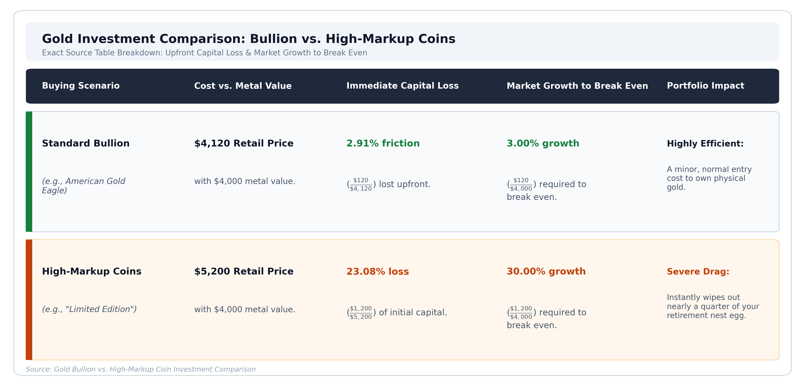
If a coin contains $4,000 worth of gold and you purchase it for $4,120, you have paid $120, or 3%, above the underlying gold value. The premium represents approximately 2.9% of your total $4,120 purchase price. Ignoring any future changes in the coin’s market premium, the underlying gold value would need to appreciate approximately 3% to reach the original purchase price.
Now consider a very different transaction.
Suppose a coin still contains approximately $4,000 worth of gold, but you pay $5,200 because it is described as “exclusive,” “premium,” or “limited.” The $1,200 premium represents approximately 23% of the $5,200 purchase price. The underlying gold value would need to increase 30% just to reach the $5,200 originally paid.
The table below contrasts a standard bullion transaction with a high-markup specialty coin transaction:
That leads to an important Gold IRA principle:
Gold can rise significantly while an investor is still recovering an excessive premium paid at the time of purchase.
Can “Limited Edition” Gold IRA Coins Carry High Markups?
Yes. A limited-mintage, exclusive, or specialty designation does not automatically mean that a coin has greater investment or resale value.
The federal enforcement action against Red Rock Secured provides a documented example.
In an April 2024 final consent order, the Commodity Futures Trading Commission found that Red Rock marketed Canadian Red-Tailed Hawk gold and silver coins as “limited quantity” even though there was no mintage limit on the coins.
The CFTC found that at least 950 customers paid more than $69 million for Red-Tailed Hawk coins that cost Red Rock approximately $30 million to acquire. Depending on the product, the order found markups ranging from approximately 91.89% to 129.97% over Red Rock’s acquisition cost. Most of these customers used tax-deferred or other retirement funds.
By comparison, according to the CFTC, customers had been told about substantially lower 1% to 5% markups on Red Rock’s common bullion products before being sold the much higher-markup Red-Tailed Hawk coins.
The federal court ultimately ordered approximately $39 million in restitution, $5.1 million in disgorgement, and $12.25 million in civil monetary penalties in the CFTC action. A parallel SEC case resulted in a final consent judgment imposing more than $76 million in disgorgement, interest, and penalties.
The takeaway is simple: “Limited” is a description. Market value has to be demonstrated.
Before paying a substantial premium for scarcity, ask whether that scarcity is real and, more importantly, whether independent buyers actually recognize additional value because of it.
3. Could I Independently Determine What My Gold Is Worth—and Sell It Somewhere Else?
This is one of the simplest ways to evaluate a Gold IRA investment.
Before purchasing a particular coin or bar, search for the exact same product from several unrelated precious metals dealers. Then consider the transaction in reverse. If you already owned the product today, what would other dealers pay you for it?
Recognized bullion products generally have broad secondary markets. Investors can compare retail prices and seek competing bids without relying exclusively on the company that originally sold them the metal.
That is very different from purchasing a proprietary or obscure product whose supposed premium may be difficult to verify outside the dealer promoting it.
A limited mintage alone does not guarantee a strong secondary market. Legitimate numismatic markets certainly exist, and genuinely rare coins can command substantial collectible premiums. But collectible rarity and bullion investing are different concepts.
For a retirement investor, the important question is whether the premium being paid today is likely to be recognized by independent buyers tomorrow.
A useful rule is:
You should not have to trust a salesperson’s opinion about what your gold is worth. You should be able to verify it yourself.
A dealer may advertise a buyback program, but an investor should preferably own products that are marketable even without relying on the original dealer.
Ask yourself: Could I readily sell this exact coin or bar to another established, independent precious metals dealer?
If the answer is unclear, understand why before buying.
4. Why Is the Gold IRA Dealer Recommending This Particular Product?
Not every gold product generates the same economics for the company selling it. That makes the reason behind a product recommendation worth understanding.
The Red Rock case again provides an instructive example. The CFTC’s final order documented substantially higher markups on Red-Tailed Hawk coins than the lower markups discussed with customers for common bullion. Regulators found that sales representatives steered customers toward the supposedly premium products carrying those higher markups.
That does not mean every specialty coin—or every commissioned precious metals salesperson—is problematic. It means investors should understand the incentives surrounding a recommendation.
If a representative strongly recommends an “exclusive,” “limited,” “premium,” “proof,” or “low-mintage” coin instead of a widely traded bullion product, ask a simple question: Why is this particular product better suited to my objectives?
Then independently verify the answer.
Claims involving scarcity, appreciation potential, resale value, or other special characteristics should be supported by evidence beyond representations from the company selling the product.
The same principle applies to promotions such as “free silver,” free storage, or other incentives. There is nothing inherently wrong with a promotion, but those benefits have an economic cost somewhere in the transaction.
Rather than focusing primarily on what you are receiving for free, come back to the more important question: What am I actually paying for the physical metal?
5. When I Pay for My Gold, When Is the Metal Actually Secured and Delivered?
This is a Gold IRA risk many retirement investors may never have considered.
The July 2, 2026, Chapter 11 bankruptcy filing of Rosland Capital in the U.S. Bankruptcy Court for the Central District of California demonstrates why a dealer’s financial condition and fulfillment practices matter.
Rosland Capital was a nationally advertised precious metals dealer. In its Chapter 11 filing, the company reported assets between $1 million and $10 million and liabilities between $50 million and $100 million.
Reporting based on the bankruptcy filings has described substantial customer payments associated with orders that had not yet been fulfilled, as well as outstanding obligations associated with precious metals buybacks.
The situation raises a question that applies well beyond any single company: What happens if a Gold IRA dealer fails before my metals are delivered?
The answer depends significantly on where the transaction stands.
There is an important difference between precious metals that have already been purchased, delivered, and properly held within an independent IRA custody and depository arrangement and money that has been transferred to a dealer for an order that remains unfulfilled.
That is why investors should understand the fulfillment process before sending retirement funds.
Ask the dealer when the corresponding metal is secured after your price is locked and funds are received. Then ask how quickly the metal will be delivered to the IRA depository.
Rosland’s bankruptcy is particularly instructive because the problem was not simply that gold performed poorly as an asset. The bankruptcy occurred during a period of substantially higher precious metals prices.
It illustrates a fundamentally different risk: dealer fulfillment risk.
An investor can be correct about the direction of gold and still face significant losses, delays, or uncertainty if the company responsible for completing the transaction cannot fulfill the order.
Brand recognition, national advertising, and celebrity endorsements cannot substitute for understanding how your precious metals transaction actually works.
The Five-Question Gold IRA Test
You do not need to become a precious metals expert before opening a Gold IRA. But you should be able to get straightforward answers to five basic questions.
What exactly will my IRA own? How much am I paying above the underlying value of the metal? Could I independently determine its value and sell it somewhere else? Why is the dealer recommending this particular product? And when I pay, when is my metal actually secured and delivered to the depository?
Straightforward answers to these questions can reveal a great deal about both the investment and the dealer’s approach to the transaction.
How Should You Choose a Gold IRA Dealer?
A trustworthy precious metals dealer should make these questions easy to answer.
At First Gold Group, we believe precious metals investing should be transparent and understandable.
That clarity begins with recognizable products and straightforward pricing. An investor considering an American Gold Eagle, Gold Buffalo, or Canadian Gold Maple Leaf should be able to identify the underlying gold value, understand the price being charged for the product, compare that price with other dealers, and independently investigate what the same product is worth in the secondary market.
Liquidity matters as well.
A dealer’s willingness to provide a two-way market can be valuable, but investors should not be economically dependent upon the original seller to establish a product’s value. Widely recognized bullion allows investors to seek competitive bids elsewhere.
That distinction is core to our philosophy.
We want to earn your business when you purchase your metals—and earn it again when you decide to sell. You should not have to return to us simply because we are the only company that recognizes the value of what you own.
Transparency also means making the economics of the transaction understandable. You should know what product is being purchased, what it costs, how that price relates to the underlying precious metal value, and what happens after your funds are transferred.
Gold IRA Risk Is About More Than the Price of Gold
Investors naturally spend considerable time asking where gold prices may go next. That matters, but it is only part of the equation.
Recent precious metals litigation and bankruptcy proceedings demonstrate why Gold IRA investors should also pay attention to product selection, dealer markups, resale value, sales incentives, and fulfillment practices.
Red Rock Secured provides a documented example of what can happen when the perceived special value of a supposedly limited product becomes disconnected from an independently verifiable market. Rosland Capital highlights a different concern. Even during a strong precious metals market, the financial condition and fulfillment practices of the dealer responsible for completing the transaction can matter.
Neither case is an argument against owning gold in an IRA. They are arguments for becoming a better-informed Gold IRA investor.
Before making a purchase, don’t simply ask whether gold belongs in your retirement strategy.
Ask what you are buying. Ask what you are paying. Find out what someone else would pay you for it. Understand why that particular product is being recommended. And know when the gold you are paying for will actually be secured.
Those five questions may ultimately matter just as much as the market price of gold itself.
First Gold Group provides precious-metals products and educational information. This material is for informational purposes only and should not be considered individualized investment, tax, or legal advice. Investors should consult appropriate financial, tax, and legal professionals regarding their individual circumstances.
Sources & Further Reading
- U.S. Commodity Futures Trading Commission — Red Rock Secured enforcement action and final consent order
- U.S. Securities and Exchange Commission — Red Rock Secured litigation release and final judgment
- U.S. Bankruptcy Court, Central District of California — In re Rosland Capital LLC, Chapter 11 filing, July 2, 2026
- Bullion Trading LLC — analysis and reporting based on Rosland Capital bankruptcy filings